What Your Bug Bounty Program Isn't Telling You (And What an AI Agent Finds in 45 Minutes)
Bug bounty researchers optimize for fast payouts, not complex chains. Agentic AI finds what they miss.

The Silent Problem With Bug Bounties
Your bug bounty program might have 200 active researchers. Some are excellent. But they all share the same economic bias: they hunt for what submits fast and pays well.
An isolated path traversal on a secondary service? Skipped. A service account exposed in a config file? Noted, set aside. An S3 bucket readable on a legacy stack? Probably never tested.
That's not negligence. That's rationality. Chaining seven weak signals into a critical report takes 40 hours. An easy P3 takes two. The market gives you what it's paid for.
The result: your real attack surface is not what your bug bounty reports describe.
Why Cross-Step Reasoning Changes Everything
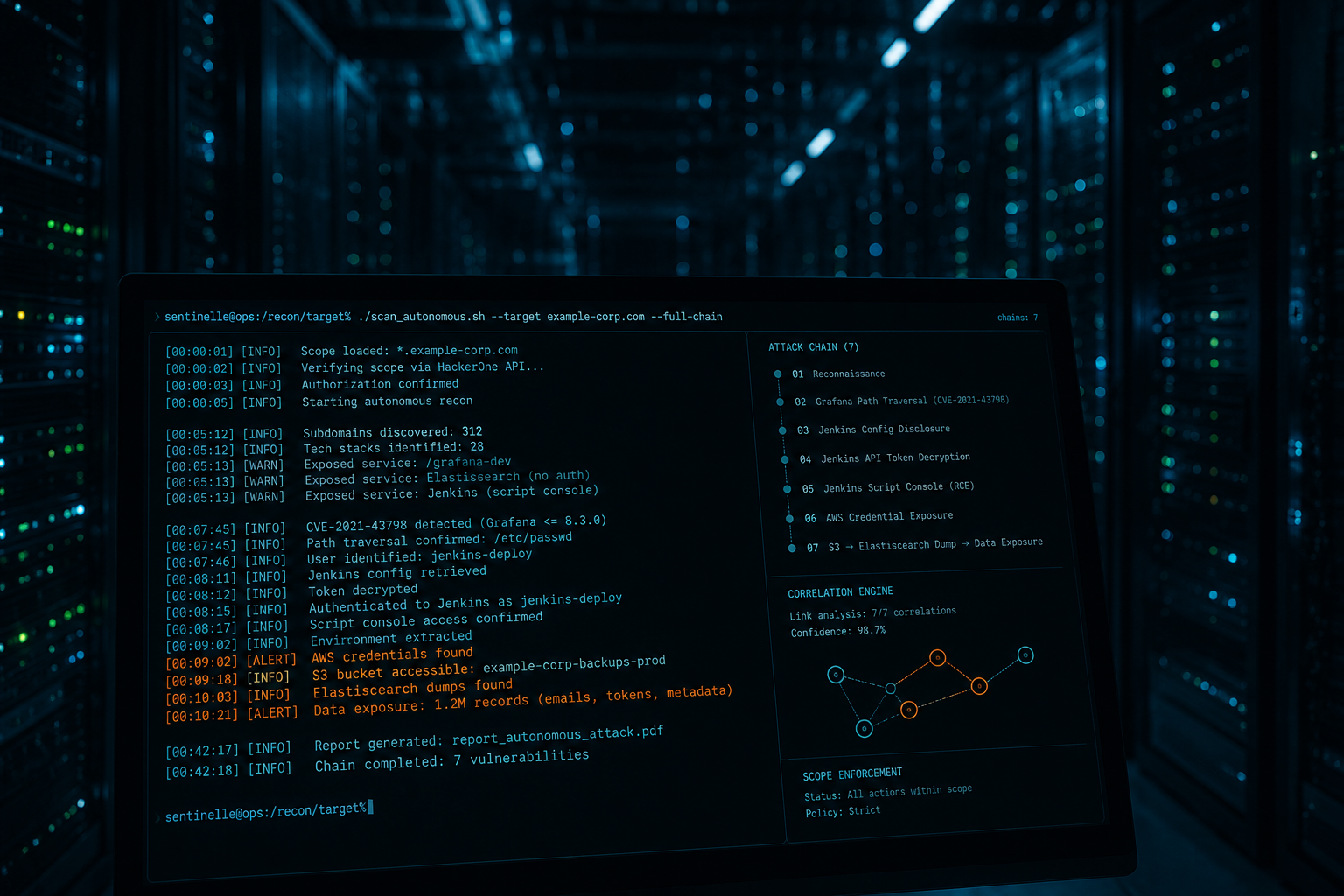
Classic scanners Nuclei, Burp, even the best orchestrators work in lists. They test a signature, move to the next. They don't remember that a jenkins-deploy account read from /etc/passwd matches a Jenkins service spotted 20 minutes earlier on a different subdomain.
That correlation reasoning is exactly what Sentinelle does natively. Not because a rule was hardcoded for it. Because an agent with contextual memory connects observations that stateless tools lose between scans.
The difference isn't speed. It's problem class.
A scanner finds what's already in its signatures. An agent finds what signatures don't describe yet the compromise paths that emerge from the combination of ordinary services.
The Target Profile Where This Actually Matters
Sentinelle isn't built for a ten-person startup with two services in prod. It's built for organizations whose attack surface is too large to audit manually at a useful frequency.
Concretely: you have more than 50 active subdomains, multiple teams deploying independently, and an annual or semi-annual pentest cycle. That's where the delta hits hardest between what your last report covers and what actually exists on your endpoints today.
The window between two pentests is exactly the window an attacker operates in. Sentinelle closes it.
What the Report Gives You And What It Doesn't
One honest point, because the industry's marketing is often vague here.
Sentinelle produces a reproducible report, command by command, with evidence truncated to avoid exfiltrating real data. It scores in combined CVSS and prioritizes remediation. A human operator validates before submission.
What it doesn't do: replace business judgment on contextual criticality. Read access on a test database and read access on a production database have the same technical score and radically different business impact. The operator decides. The agent delivers.
That's the model. Not a replacement for human judgment an amplification of analytical capacity across surfaces you couldn't cover alone.
The Test You Can Run Today
Take a perimeter your team audited in the last six months. Run Sentinelle on it. Compare the two reports.
If ours finds nothing yours missed, you have an excellent team and you don't need us. Write to me I enjoy those conversations.
If the opposite is true, you know what that means for your current audit cycle.
Did you enjoy this article?

Written by
Chris
Tech builder · Agentic AI & offensive security
A tech-obsessed builder, I'm building Sentinelle — an autonomous offensive-security AI agent. I write here about agentic AI, AI-assisted pentesting, and what I learn shipping offensive tooling.